
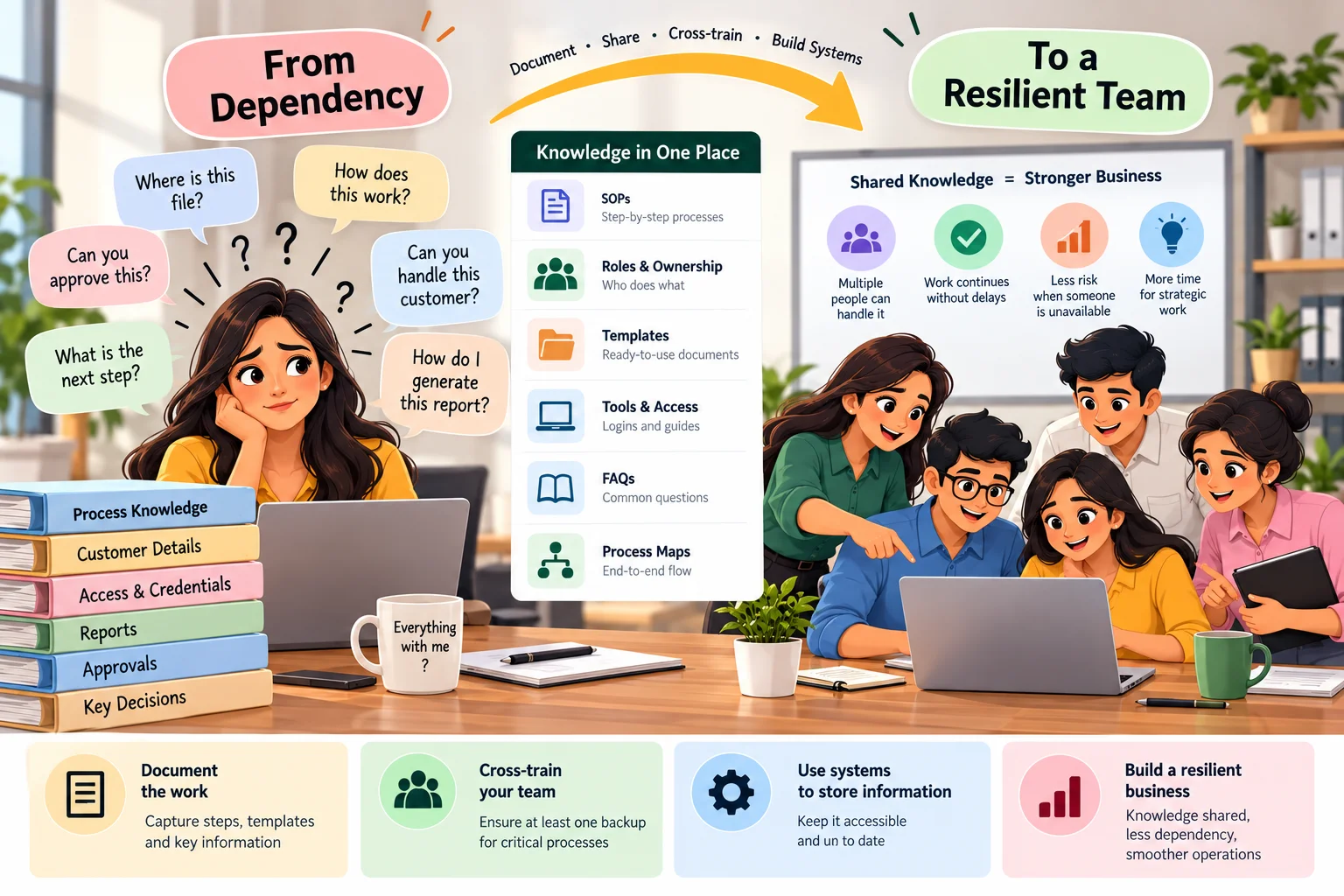
Every business has people who know more than others.
Someone knows the customers better.
Someone knows the finance process inside out.
Someone knows how the technology works.
Someone knows exactly how to handle a particular operational situation.
Having experienced people is a good thing.
The problem begins when the business cannot function without them.
When expertise becomes dependency
Imagine one employee is responsible for a process.
Everyone knows:
“Ask her. She knows how this works.”
Now she goes on leave.
Suddenly people are searching for information.
Someone calls her.
Someone checks old emails.
Someone tries to recreate the process.
Something gets delayed.
This tells you something important.
The employee wasn't just performing the process.
The employee was carrying the process in their head.
Why does this happen?
Usually, it happens gradually.
A capable employee solves a problem.
Then another.
Then another.
Eventually, everyone starts depending on that person.
The business becomes comfortable with it because things get done.
But the dependency becomes invisible.
Until that person is unavailable.
Or resigns.
Or moves to another role.
Then the gap becomes obvious.
Start by identifying critical dependencies
You don't need to eliminate every dependency.
Start with the important ones.
Ask:
What processes can only one person perform?
What information is only one person aware of?
What decisions are only one person authorised to make?
What customer relationships depend entirely on one employee?
What systems or reports does only one person know how to operate?
Those are your risk areas.
Document the work
The first step is usually documentation.
But documentation should be practical.
Not:
“Write a 40-page manual.”
Instead:
What is the task?
What triggers it?
What are the steps?
What information is required?
What are the common exceptions?
Who needs to be informed?
What does completion look like?
A checklist can be enough for some processes.
Cross-train people
If something is business-critical, ask:
“Who else could do this if the primary person was unavailable?”
That person doesn't need to perform the task every day.
But they should understand it well enough to step in.
This creates operational resilience.
Separate relationship from information
This is especially important for customer-facing roles.
If one employee has a strong relationship with a customer, that relationship is valuable.
But important customer information should not exist only in that person's WhatsApp chats or memory.
Customer history.
Commitments.
Follow-ups.
Payments.
Important conversations.
These should have an appropriate place in the organisation's systems.
That protects both the business and the employee.
Build redundancy into important processes
For critical activities, I like the idea of:
Primary owner
Backup owner
Documented process
Defined escalation
This doesn't mean two people need to do the same job.
It means the business has a second line of support when necessary.
Don't make your best people carry the entire business
Sometimes dependency is actually a sign of appreciation.
A capable employee keeps getting more responsibility because everyone trusts them.
Eventually they become the person everyone goes to.
That may feel like recognition.
But it can become a burden.
The best employees should be helping the business become stronger, not becoming the only reason the business works.
My thought
A business should value its key people deeply.
But it should also protect them.
If one person's absence can bring an important process to a halt, the solution isn't necessarily to reduce that person's importance.
The solution is to transfer knowledge, create backups and build systems around expertise.
The strongest businesses don't depend on one person knowing everything.
They build enough structure that knowledge can move.
People should be important to the business. The business should not become helpless without them.
Vinitaa Vinod
Founder, ORGOOK Solutions