
Most businesses think about growth in terms of revenue.
More customers.
More sales.
More employees.
More locations.
More products.
But there is another side of growth that doesn't always get enough attention.
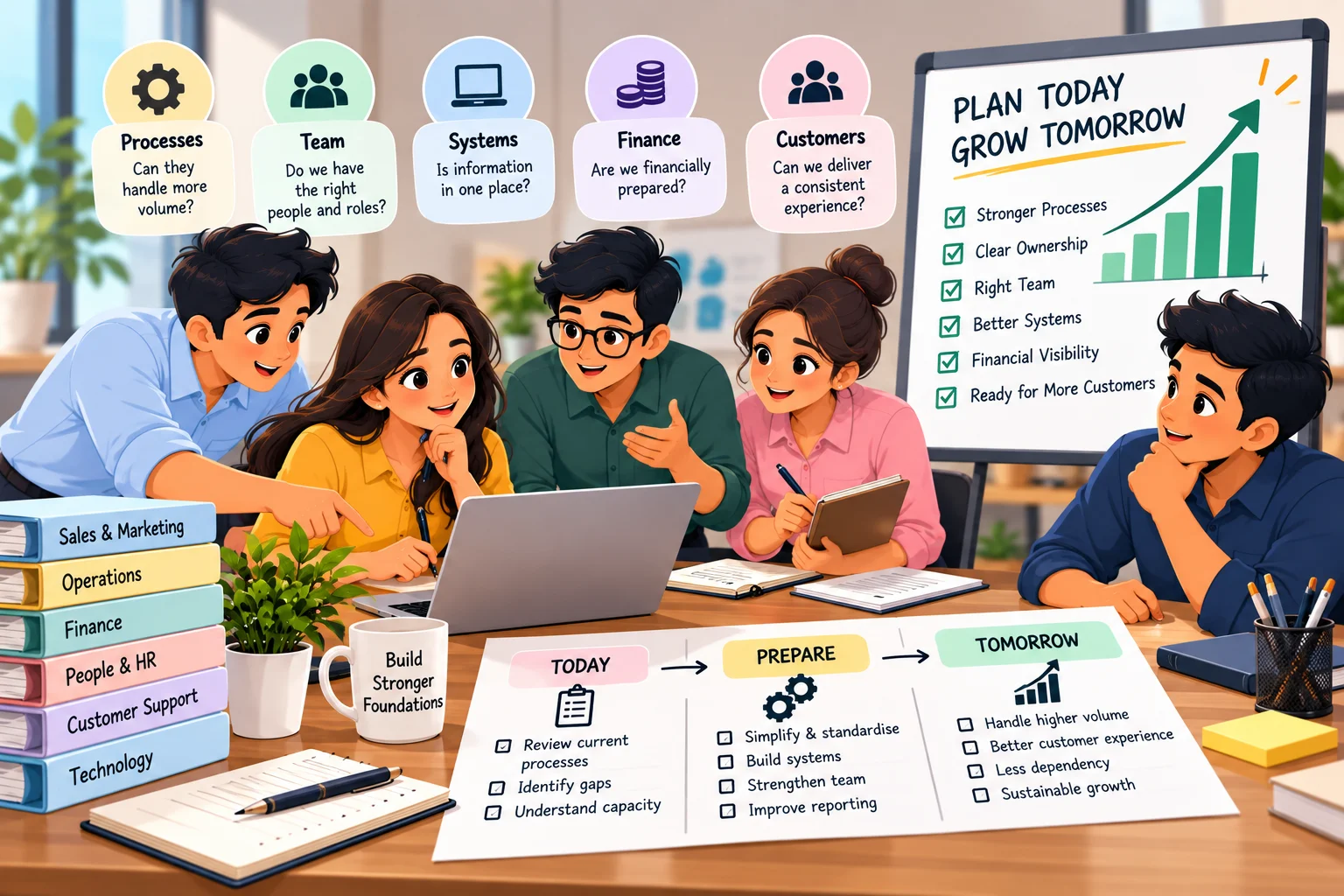
Can the business handle the growth it is trying to create?
Getting 100 new customers sounds wonderful.
Unless your onboarding process can only handle 30.
Hiring 20 people sounds exciting.
Unless nobody has time to train them.
Increasing sales sounds positive.
Unless your delivery team is already overloaded.
Growth exposes the gaps that were easy to ignore when the business was smaller.
Growth doesn't just increase volume
It increases complexity.
When you have ten customers, you may remember important details.
At a hundred customers, you need systems.
When you have five employees, everyone may know what everyone else is doing.
At thirty employees, you need clearer roles.
When the founder personally checks everything, it may work for a while.
As the organisation grows, it becomes a bottleneck.
Growth changes the operating requirements of the business.
Start with your core processes
Before expecting significant growth, look at the processes that carry the customer journey.
How does a lead become a customer?
How is payment confirmed?
How does onboarding happen?
How is the product or service delivered?
How are complaints handled?
How are renewals managed?
Where does customer information live?
Where do handoffs happen?
These processes need to be reliable enough to handle higher volume.
Look at your people structure
Ask:
Who owns each function?
Who makes decisions?
Who manages whom?
Where are the gaps?
Where is the founder still directly involved?
Where are managers overloaded?
Where is one employee carrying too much knowledge?
Growth often exposes unclear organisational structures.
It is much easier to address these questions before the pressure becomes intense.
Know your numbers
You don't need hundreds of metrics.
But you need to understand the numbers that tell you whether the business is healthy.
Revenue.
Collections.
Margins.
Customer acquisition.
Customer retention.
Operational capacity.
Employee productivity.
Outstanding work.
The exact metrics depend on your business.
But growth without visibility can create surprises.
Prepare your team before you need them
One mistake businesses make is hiring only after they are overwhelmed.
New employees arrive into chaos.
Training gets rushed.
Mistakes increase.
A better approach is to understand where the next capacity constraint will appear.
What happens if sales increases by 30%?
What happens if customer volume doubles?
What happens if one key employee leaves?
What happens if the founder becomes unavailable?
These questions are uncomfortable.
They are also useful.
Don't confuse growth with readiness
A business can grow rapidly and still have weak foundations.
Revenue can increase while processes remain messy.
Customers can increase while service quality declines.
Employees can increase while accountability becomes unclear.
Growth is not proof that the operating model is ready for the next stage.
It simply tells you that demand exists.
The business still needs to build the capacity to serve that demand consistently.
Build before the pressure arrives
You don't need to build a huge corporate structure when you are still a small business.
But you should start putting simple foundations in place.
Clear roles.
Basic SOPs.
Defined ownership.
Management reporting.
Decision-making authority.
Customer information systems.
Financial visibility.
Regular reviews.
These don't need to be complicated.
They just need to exist.
My thought
I don't think a business needs to become “big company-like” to prepare for growth.
In fact, I prefer simple systems.
The question is not:
“How much structure can we create?”
It is:
“What structure does the next stage of the business require?”
You don't need ten layers of management when you have ten people.
But you may need clearer ownership when you move from ten to thirty.
You don't need a sophisticated technology stack when your volume is low.
But you may need better systems when manual work starts creating delays.
Growth should not force you to build everything overnight.
Build the next layer before the current one starts breaking.
That is what makes growth sustainable.
Vinitaa Vinod
Founder, ORGOOK Solutions