
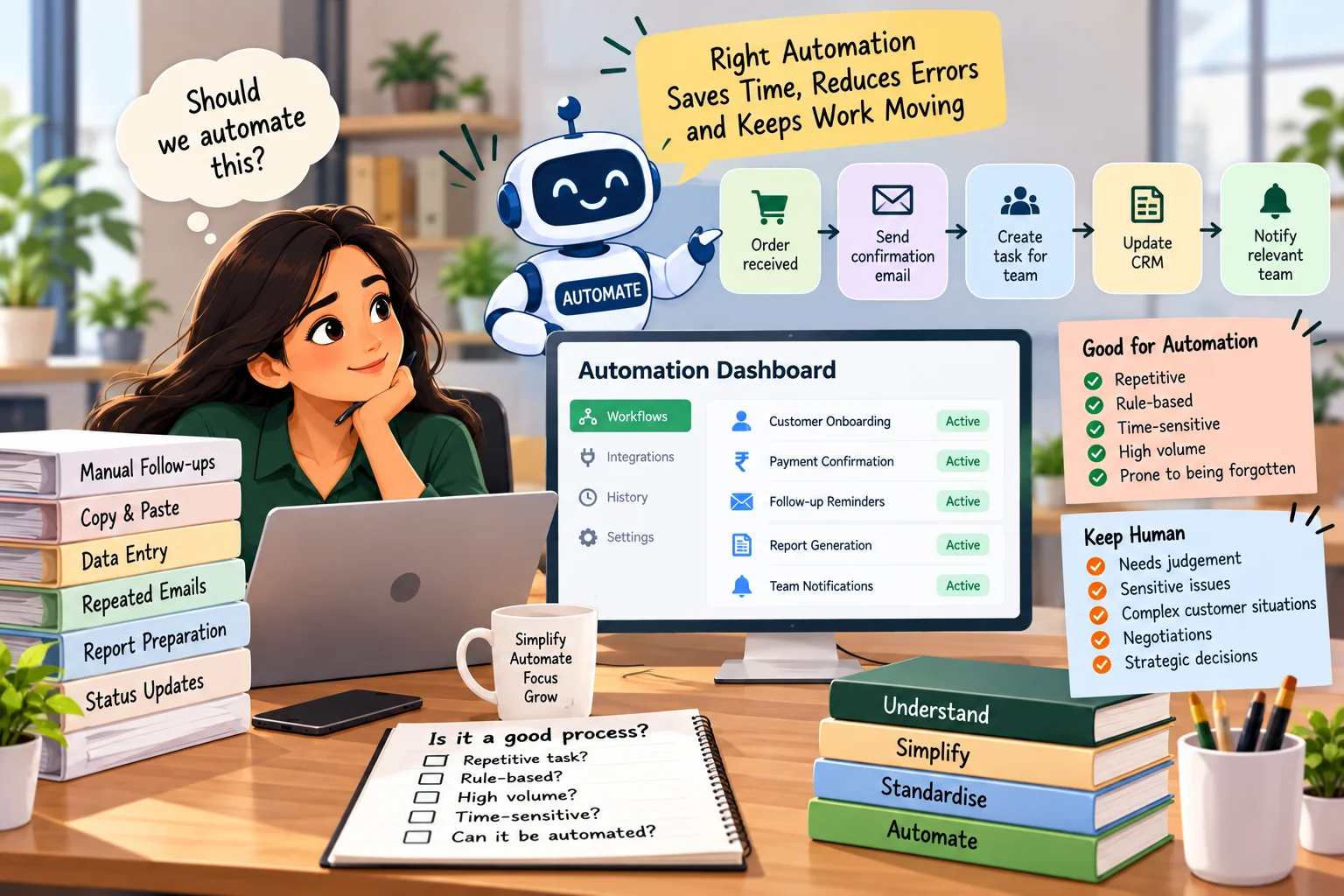
Automation is one of those words that sounds exciting.
Automate your follow-ups.
Automate your reports.
Automate your onboarding.
Automate your customer communication.
Automate your workflows.
And yes, automation can make a huge difference.
But there is one question I would ask before automating almost anything:
Is this actually a good process?
Because if it isn't, automation may simply help you do the wrong thing faster.
First fix the process
Imagine a customer onboarding process with eight unnecessary steps.
Instead of simplifying it, the business creates an automation that moves the customer through all eight steps automatically.
Technically, it works.
Operationally, the business is still carrying unnecessary complexity.
The automation didn't solve the process.
It simply automated it.
That is why I prefer this sequence:
Understand → Simplify → Standardise → Automate
Not:
Automate → Figure out the problems later
Where automation can genuinely help
Automation is particularly useful when a task is:
Repetitive
Rule-based
Time-sensitive
High-volume
Prone to being forgotten
For example:
A payment is received.
The CRM needs updating.
A confirmation needs to be sent.
The next task needs to be created.
The relevant team needs to be notified.
That is a good candidate for automation because the trigger and next steps are relatively clear.
Don't automate decisions that need judgement
Some things should remain human.
A complicated customer complaint.
A sensitive employee matter.
A negotiation.
A strategic decision.
An unusual financial situation.
A relationship that requires context.
Automation should support judgement, not replace it where judgement is actually required.
Look for repetitive manual work
One of the easiest places to start is your team's daily work.
Ask:
What do people copy and paste repeatedly?
What information is entered into multiple systems?
What reminders are manually sent?
What reports are prepared in the same format every week?
What tasks are frequently forgotten?
What notifications could happen automatically?
Those are good areas to investigate.
Automation needs an owner
This is often overlooked.
Someone needs to own the automation.
Who checks whether it is working?
Who updates it when the process changes?
Who handles exceptions?
Who notices when the automation fails?
Automation isn't completely “set and forget”.
It becomes another part of your operating system.
Don't automate because everyone else is doing it
A business does not become sophisticated because it has twenty automations.
It becomes more effective when the right work happens with less unnecessary effort.
Sometimes the answer is automation.
Sometimes it is a better SOP.
Sometimes it is removing a step.
Sometimes it is simply giving someone clearer ownership.
Technology is one tool.
It isn't the solution to every operational problem.
My thought
I like automation when it removes repetitive work and gives people more time to focus on work that actually requires people.
But I am equally comfortable saying:
“Don't automate this yet.”
Sometimes the process needs to be fixed first.
Sometimes the volume isn't high enough to justify it.
Sometimes a simple checklist is better.
And sometimes the human interaction is actually the valuable part.
The question isn't:
“What can we automate?”
A better question is:
“What should happen automatically, what should happen through a process, and what should remain human?”
That is where automation starts creating real value.
Vinitaa Vinod
Founder, ORGOOK Solutions