When people hear the words “operating system”, they often think about software.
But when I talk about a business operating system, I mean something very different.
I mean the way the business actually runs.
How decisions are made.
How work moves.
How people know what they are responsible for.
How information is captured.
How performance is reviewed.
How problems are escalated.
How processes are documented.
How the founder gets visibility without being involved in everything.
That is an operating system.
Every business already has one
Even if you haven't deliberately designed one, your business already has a way of operating.
The question is whether it is intentional.
Maybe approvals happen through WhatsApp.
Maybe customer information sits in someone's notebook.
Maybe the founder knows which employee to call when something goes wrong.
Maybe weekly reviews happen whenever there is a problem.
Maybe the finance team maintains one spreadsheet while Operations maintains another.
That is still a system.
It is just an informal one.
The problem with informal systems
They work surprisingly well when the business is small.
Everyone knows everyone.
Information travels quickly.
The founder is accessible.
People remember what happened.
But growth changes that.
More people join.
More customers arrive.
More departments appear.
More information gets created.
Suddenly, the informal system starts breaking.
What should an operating system contain?
There isn't one universal model.
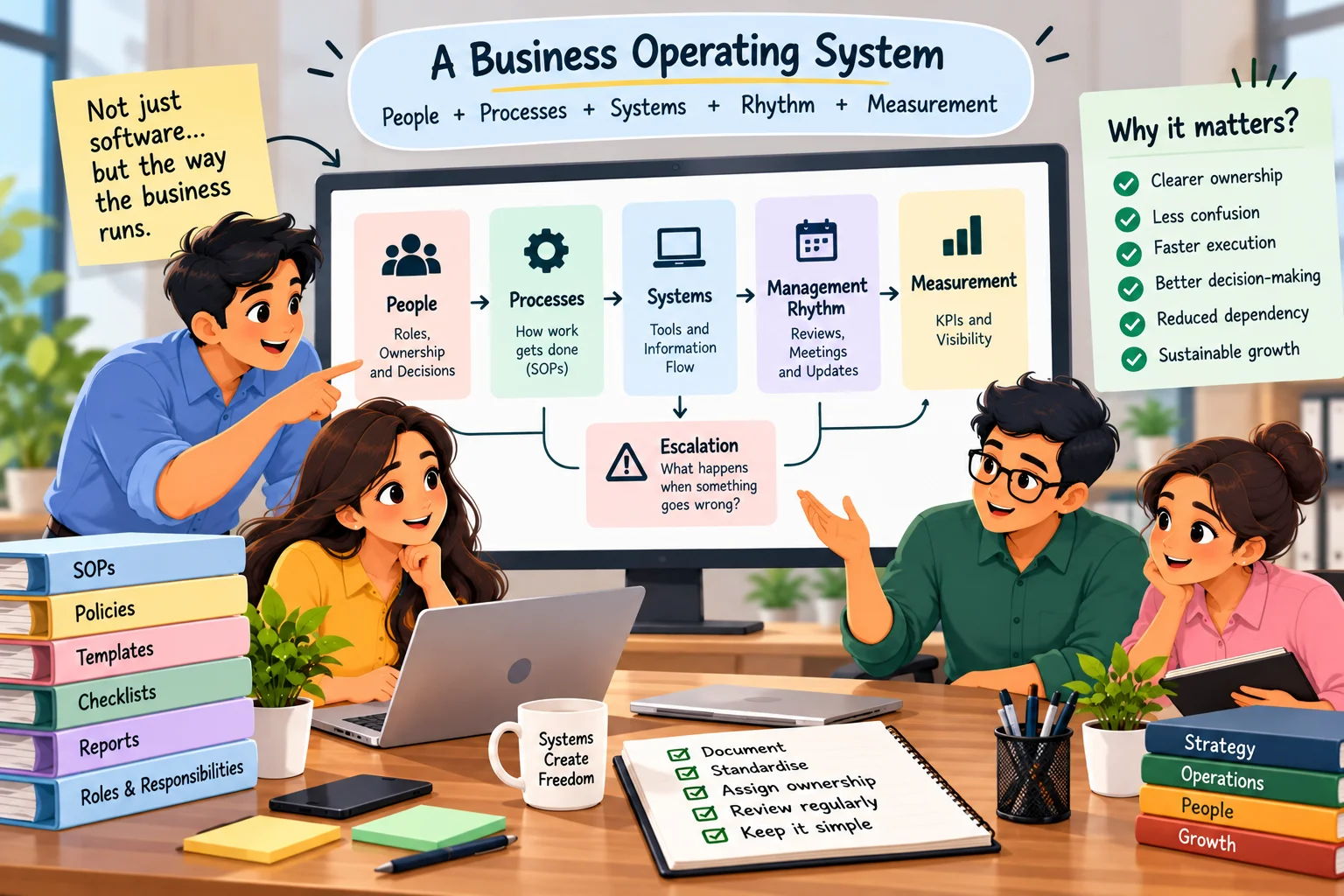
But I believe there are a few essential parts.
People
Who is responsible for what?
Who reports to whom?
Who makes which decisions?
Processes
How is important work done?
What happens first?
What happens next?
Systems and tools
Where is information stored?
Which tools are used?
How does information move between them?
Management rhythm
When do teams review performance?
When are issues discussed?
How are decisions recorded?
Measurement
How do you know whether things are working?
Escalation
What happens when something goes wrong?
These elements work together.
SOPs are only one part of the system
This is important.
A business can have hundreds of SOPs and still have poor operations.
Why?
Because documentation alone doesn't create accountability.
Suppose you have an SOP for customer onboarding.
But nobody owns onboarding.
The SOP exists.
The process exists.
The document exists.
But the customer still gets missed.
The operating system connects:
Process + Ownership + Execution + Measurement
That is what makes the process work.
The founder should be able to see the business without touching everything
This is one of the biggest benefits of a good operating system.
The founder shouldn't need to personally check every task to understand what is happening.
There should be visibility.
Dashboards.
Reviews.
KPIs.
Reports.
Escalation mechanisms.
Clear ownership.
The founder can then focus on questions like:
Where are we going?
What should we change?
Where should we invest?
What opportunities should we pursue?
Instead of:
“Did this task get completed?”
An operating system should also evolve
Your business won't remain the same.
Your operating system shouldn't either.
A process that works today may need to change six months from now.
Your team will change.
Your customers will change.
Technology will change.
Your products may change.
So the operating system needs regular review.
Not constant change.
But intentional review.
Don't over-engineer it
This is another mistake I see.
A small business discovers operating systems and immediately starts building:
Twenty dashboards.
Fifty SOPs.
Multiple approval layers.
Too many meetings.
Too many tools.
That isn't necessarily good operations.
Good operations should create clarity without creating unnecessary bureaucracy.
Start with the areas causing the most friction.
Fix those.
Then build from there.
My thought
A business becomes easier to run when people don't have to rely on memory, guesswork and constant follow-up.
People know what they own.
Processes are visible.
Information is accessible.
Managers know what needs attention.
The founder has visibility without having to personally control everything.
That is what I mean by an operating system.
It isn't a piece of software.
It isn't a collection of SOPs.
It is the way the business works when everyone knows how to move the work forward.
And when that system is designed well, the business becomes less dependent on individual heroics and more capable of growing consistently.
The objective isn't to make a business more complicated.
It is to make the business easier to run.
Vinitaa Vinod
Founder, ORGOOK Solutions