
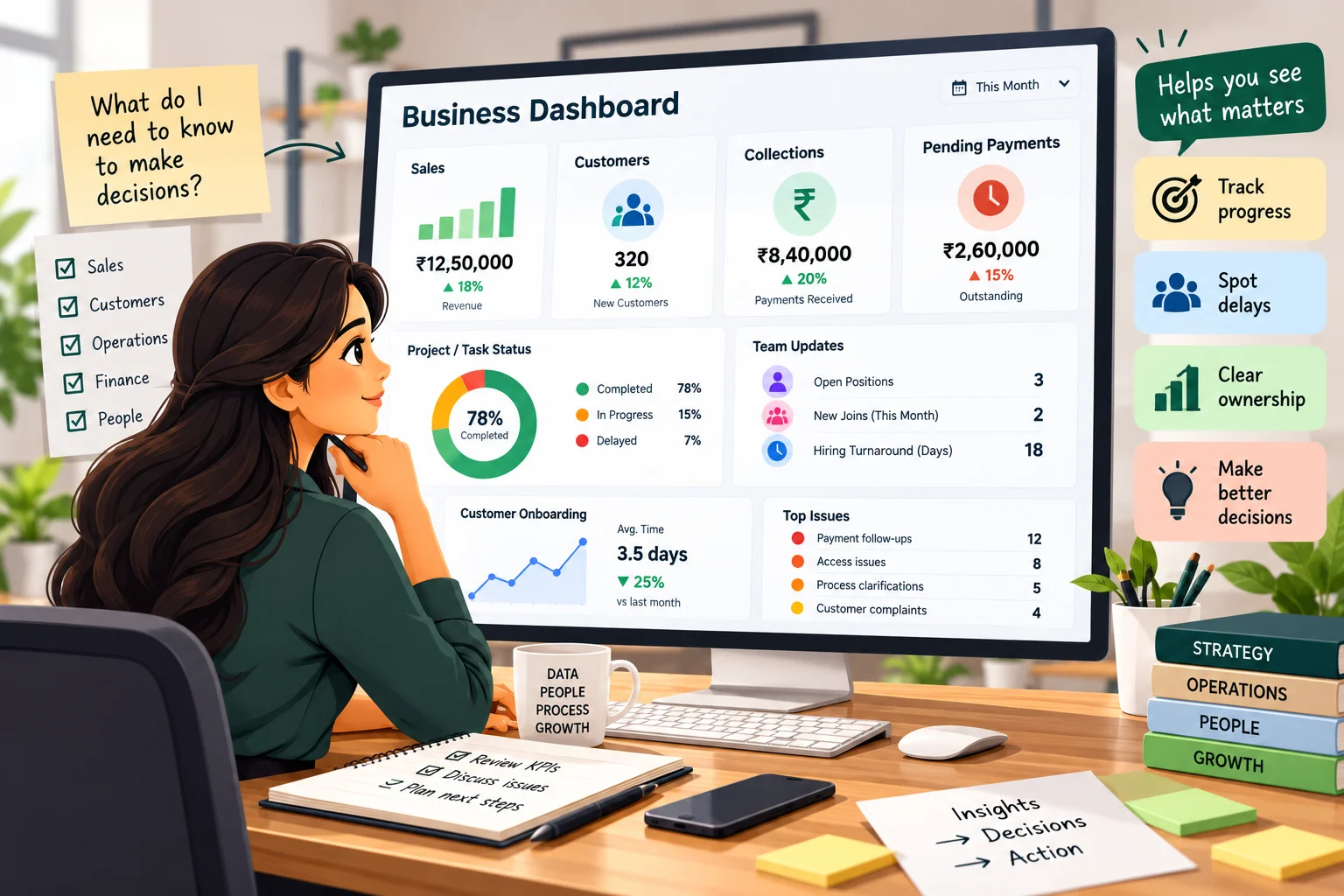
I have seen businesses with impressive dashboards.
There are charts everywhere.
Numbers.
Graphs.
Percentages.
Targets.
Colour coding.
Multiple tabs.
And then someone asks:
“So, what do we need to act on?”
Silence.
That is when I think the dashboard has become a reporting tool instead of a management tool.
A good management dashboard should not make you work harder.
It should help you see what needs your attention.
Start with decisions, not data
Before building a dashboard, ask:
What decisions do I need to make every week?
That question should come before:
“What data do we have?”
For example, a founder may need to know:
Are sales on track?
Where are customers getting stuck?
What payments are pending?
Which department has unresolved issues?
Are important tasks being completed?
Are hiring requirements moving?
Which operational problems are repeating?
Those are management questions.
The dashboard should help answer them.
Don't put everything on one screen
A common mistake is trying to measure everything.
Sales.
Marketing.
Finance.
HR.
Operations.
Customer support.
Attendance.
Tasks.
Revenue.
Leads.
Conversions.
Complaints.
Everything.
Eventually, the dashboard becomes so crowded that nothing stands out.
A useful dashboard should answer:
What is happening?
What has changed?
What needs attention?
Who owns it?
Every number should have an owner
This is one of the most important principles.
Suppose your dashboard shows:
Pending Payments: ₹8,40,000
That number is useful.
But what happens next?
Who is responsible?
Which payments are overdue?
How old are they?
Who is following up?
When is the next action?
A number without ownership doesn't necessarily create action.
So for important metrics, define:
Metric → Owner → Target → Current status → Action
Now the dashboard becomes operational.
Keep the number of KPIs manageable
You don't need 50 KPIs.
For each function, identify the few numbers that genuinely tell you whether things are working.
For example:
Sales
Leads → Conversions → Revenue
Operations
Pending tasks → Turnaround time → Escalations
Finance
Collections → Outstanding payments → Cash position
HR
Open positions → Hiring turnaround → Attrition
The exact KPIs will vary.
The principle remains the same:
Measure what helps you manage.
The dashboard should show exceptions
This is where a good dashboard becomes powerful.
If everything is on track, you shouldn't have to spend most of your meeting discussing it.
You should be able to focus on:
What is delayed?
What has fallen below target?
What changed unexpectedly?
What requires a decision?
What has been pending too long?
The dashboard should help bring these things to the surface.
A dashboard is not a substitute for management
This is important.
A dashboard can tell you that customer onboarding is taking longer.
It cannot automatically tell you why.
That requires a conversation.
Maybe the Operations team is understaffed.
Maybe Sales isn't passing complete information.
Maybe the process has too many steps.
Maybe the technology isn't working properly.
The number tells you where to look.
Management determines what to do about it.
My thought
I don't believe every business needs a complicated BI system.
Sometimes a well-designed Google Sheet is enough.
Sometimes the business needs a CRM dashboard.
Sometimes it needs a proper management reporting system.
The technology should come after the management requirement.
The real test is simple:
Can the founder or manager look at the dashboard and quickly understand what needs attention?
If yes, it is doing its job.
If people spend more time preparing the dashboard than using it, something needs to change.
A good dashboard doesn't just show you what happened. It helps you decide what to do next.
Vinitaa Vinod
Founder, ORGOOK Solutions